


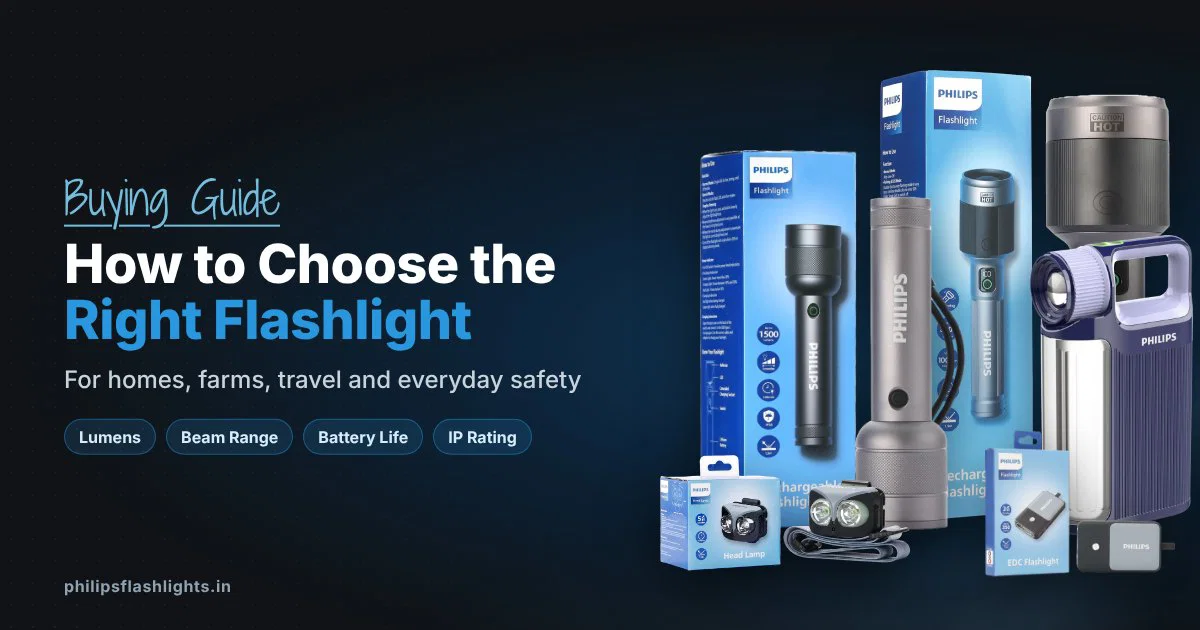
How to Choose the Right Flashlight: A Simple Guide for Indian Homes, Farms and Outdoors 1
A good torch is one of the most useful things you can own, whether you live in a city flat or a village home. Think of the evening walk around the colony, taking the dog out before bed, a quick round of the house compound to lock the gate, a power cut in the middle of dinner, finding the inverter switch or the MCB in the dark, checking the car in a dim basement parking, arriving late at a poorly lit bus stand, a breakdown on the highway, a trek in the Western Ghats, or a long night of irrigation in the fields. In each case, the right light makes the job easier and safer.
But torches today come with a lot of numbers on the box. Lumens, metres, mAh, IP55. This guide explains what each one means in plain words, so you can pick the right flashlight for your needs and your budget.
In a hurry? Tap what you need the torch for and see the best matches with today’s prices and stock.
Open the Flashlight FinderWhy a Good Torch Still Matters in India
Electricity supply across India has improved a great deal over the last decade, and most homes now get power for most of the day. Even so, government reports show that supply can still fall short in many areas, and storms, monsoon faults and scheduled maintenance mean short outages are part of life in cities and villages alike. In apartment buildings, a power cut can leave lifts, staircases and parking areas dark, and an inverter rarely covers every room.
Outside the home, reports from several states note that many village roads and lanes are still not lit at night, and even in cities, back lanes, parks and building compounds can be dark. A dependable handheld light is still how many families find their way after dark.
Step 1: Start With What You Need It For
The best torch for a farmer is not the best torch for a college student or a biker. Start with how you will use it.
For Home and Power Cuts: Torch and Lantern in One
During a power cut you usually need two kinds of light. A torch beam is focused and reaches far: use it to walk to the main switch, check the inverter, find the gas knob or step out to the gate. A lantern spreads soft, even light all around: stand it on the dining table or hang it from a hook, and the whole room is lit for dinner, homework or getting the children to bed.
Several Philips models give you both in one body, so you don’t need two separate lights. And like every Philips flashlight, they charge with a USB Type-C cable, the same one most phones use, so you can top them up from a phone charger or a power bank when the power comes back. The SFL3451 combines a 15W zoom torch with a 10W lantern, each with high and low modes, and its listing quotes up to 200 hours of lantern light on low. The SFL3402 has separate buttons for the torch, a COB lantern and a coloured RGB mood light. The SFL1183 and SFL1188 add a side light that works as a desk, reading or repair lamp.
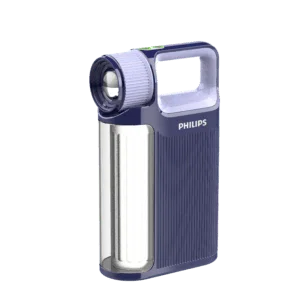 SFL3451Philips Zoom Torch + LanternZoom torch plus lantern with IP44 protection. A lantern for the room and a beam for the gate.1,000 lm325 m beamUp to 20 hIP44View Details →
 SFL3402Philips Torch + Lantern + RGB LightTorch, COB lantern and RGB mood light with three separate buttons and a carry handle.1,000 lm100 m beamUp to 20 hView Details →
 SFL1183Philips Torch with Camping LightA torch that turns into a soft camping light. Easy for anyone in the family to use.400 lm150 m beamUp to 15 hIP44View Details →
 SFL1188Philips Torch with Side LightA torch with a side light for the study table, reading or fixing something in the dark.400 lm150 m beamUp to 15 hIP44View Details →
If you only need a simple, reliable torch for every room, the SFL1181 Everyday Torch is the most affordable choice, and the SFL6166R gives 1,500 lumens in a compact aluminium body that runs up to 30 hours on low.
For Women’s Safety and Everyday Carry
Many women walk home from work, college or tuition after dark, wait at auto stands and bus stops, or cross lanes without street lights. Safety audits in Indian cities have repeatedly pointed to poorly lit stretches as places where people feel less safe.
A light you actually carry every day is worth more than a powerful one left at home. Look for something small enough for a handbag or pocket, bright enough to light up the path ahead, and with a strobe mode. A fast, bright strobe draws attention from people nearby and can startle or briefly dazzle someone, or a stray dog, coming towards you, which gives you a moment to move away and call for help.
 SFL3403Philips Pocket Torch with UVJust a little bigger than a credit card and only 66.5 g, so it slips easily into any handbag. Strobe, SOS and UV, and it survives a 1 m drop.350 lmView Details →
 SFL2141Philips Slim Zoom TorchA 149 mm aluminium torch with zoom and strobe that survives a 1 m drop, for more reach in a pocket size.650 lm300 m beamUp to 8 hView Details →
 SFL2186RPhilips 15cm LED Torch910 lumens, strobe, IP55 and 1.5 m drop resistance in a 151 mm body.910 lm300 m beamUp to 12.5 hIP55View Details →
For Farms and Large Open Land
Indian farmland stretches far, and much of the work happens after dark. In many areas, power for irrigation pumps comes at night, so farmers walk to the fields, start pumps and check channels in the dark, where snakes and animals are hard to see. Schemes to shift farm power to daytime are expanding, but night work is still common.
For this work you need two things: a long-range torch to see far across the field, and a head-mounted light that leaves both hands free for pipes, valves and tools.
 SFL5102Philips Heavy-Duty Zoom TorchThe most powerful torch in the range: a 1 km beam, a 9000 mAh battery and 1.5 m drop resistance for large farms and estates.3,000 lm1,000 m beamUp to 30 hView Details →
 SFL5101Philips Long-Range Zoom Torch2,300 lumens and an 850 m beam in a lighter 540 g body.2,300 lm850 m beamUp to 19 hView Details →
 SFL3342RHPhilips Owl-Eye HeadlampHands-free light for the pump and channels. Wave your hand to switch it on, even with wet hands.450 lm135 m beamUp to 25 hView Details →
 SFL3153RHPhilips Multi-Functional HeadlampAn IP55 headlamp for work in the rain, with a clip that fits on a cap.220 lm100 m beamUp to 15 hIP55View Details →
For Biking, Road Trips, Trekking and Camping
Bike rides to the hills, long drives on the highway, treks to temples and forts, and weekend camping are a big part of travel in India. Things rarely go wrong in daylight. A light in your bag or under the seat helps with the moments that happen after sunset:
- A puncture or breakdown at night: switch on the hazard lights and place the warning triangle, then use a headlamp so both hands are free to change the tyre or check the engine. Never flash a strobe at oncoming vehicles: it can dazzle drivers and cause an accident.
- Ghat roads and forest stretches: a long beam shows what is ahead on a dark road or trail, including animals on the road.
- At the campsite or homestay: a lantern lights the tent or the room, and a torch is for the walk to the washroom.
- Cycling and biking after dark: the SFL3153RH headlamp has red and blue side lights. Long press to turn on the red side light, then click to switch between flashing red, slow flashing red and blue, and alternating fast and slow red and blue, so vehicles behind you, including trucks and buses, can see you from a distance.
- Monsoon rides and treks: choose a torch with an IP rating, so rain and splashes don’t stop it.
- Charging on the road: every Philips flashlight charges over USB Type-C, so a power bank or the car’s USB port keeps it going.
- Pilgrimage treks before dawn: a headlamp keeps your hands free for the walking stick and the railings.
 SFL2143Philips 225mm Zoom TorchA 950 m zoom beam and up to 28 hours on low.1,100 lm950 m beamUp to 28 hView Details →SFL3451Philips Zoom Torch + LanternZoom torch and lantern in one for the campsite, with USB Type-C charging.1,000 lm325 m beamUp to 20 hIP44View Details →SFL3153RHPhilips Multi-Functional HeadlampA headlamp with red and blue flashing side lights, so trucks, buses and cars see you on the bike or cycle.220 lm100 m beamUp to 15 hIP55View Details →SFL3342RHPhilips Owl-Eye HeadlampA 60 g headlamp for roadside repairs and pre-dawn treks.450 lm135 m beamUp to 25 hView Details →SFL2186RPhilips 15cm LED TorchCompact, IP55 and 1.5 m drop resistance. Fits a tank bag or glovebox.910 lm300 m beamUp to 12.5 hIP55View Details →
For Security, Railway, Fire and Rescue, and Defence Personnel
Many people work through the night: watchmen and security guards on rounds, railway staff on night inspections, fire and rescue teams, police patrols and armed forces personnel. They need reach, a zoom to switch between spot and flood, a battery that lasts the shift, a strong body that survives drops, and a strobe for signalling. Look for a beam of 600 m or more and an aluminium alloy body. For official duty, always follow your department’s equipment rules.
SFL5102Philips Heavy-Duty Zoom Torch3,000 lumens, a 1 km beam and 1.5 m drop resistance for large premises, yards and search work.3,000 lm1,000 m beamUp to 30 hView Details → SFL2142Philips 192mm Zoom TorchA 900 m beam and 1 m drop resistance at a mid-range price, a good everyday duty torch.1,000 lm900 m beamUp to 12.5 hView Details →
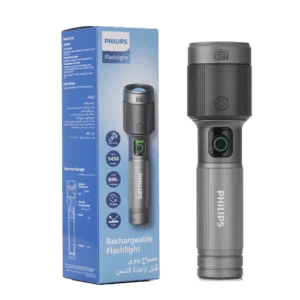 SFL5141Philips Compact Long-Range Zoom Torch1,450 lumens and a 690 m beam with a 1.5 m drop resistance.1,450 lm690 m beamUp to 12.5 hView Details →
 SFL2101Philips Compact Zoom Torch1,450 lumens and a 600 m beam in a compact 162 mm body.1,450 lm600 m beamUp to 12.5 hView Details →
Real-Life Situations: Which Torch Helps?
The lifts stop, the staircase is dark and the children have homework.
Good choice: SFL3451 or SFL3402 (torch + lantern)Parks and back lanes are poorly lit, and traffic needs to see you.
Good choice: SFL3153RH headlamp with flashing red and blue side lights, hands free for the leash, or the compact SFL2141The walk home is short but dark.
Good choice: SFL3403, a little bigger than a credit card, in your handbagLocking the gate, checking the water tank or the terrace.
Good choice: SFL1181 or SFL6166RHazard lights and warning triangle on, and both hands free for the tyre.
Good choice: SFL3342RH or SFL3153RH headlampLong walks, wet ground, snakes and a pump to start.
Good choice: SFL5102 + SFL3153RH headlampYou want to see the far end of the plot without walking out.
Good choice: SFL5101 or SFL2143Riders behind you need to see you on an unlit road.
Good choice: SFL3153RH headlamp with flashing red and blue side lightsStep 2: How Many Lumens Do You Need?
Lumens measure how much light a torch gives out. More lumens means brighter light, but also more battery use, so more is not always better.
| Lumens | What it can light up | Good for |
|---|---|---|
| Under 300 | A room | Reading, headlamps, close work |
| 300 to 700 | A house compound | Home use, walking at night |
| 700 to 1,500 | A whole street | Outdoor use, travel, camping |
| 1,500 to 2,500 | An open field | Farms, large premises |
| 2,500 and above | Floodlight-level brightness | Security, search, very large areas |
Indoors, a very bright torch can dazzle, which is where stepless dimming helps (see Step 7).
Step 3: Beam Distance and Zoom
Beam distance tells you how far the light reaches. A football pitch is about 105 metres long, so a 950 m beam reaches roughly nine pitches away.
A zoom torch lets you slide the head to switch between a narrow, long spot beam and a wide flood beam. It is the most useful single feature for outdoor, travel and farm use: spot to see far, flood to light up the area around you. A steady spot beam also helps you find a pet that has slipped away in the dark, because it catches the reflection of the animal’s eyes.
Step 4: Battery Life and Charging
- Battery capacity (mAh): a bigger number usually means longer runtime. Philips torches range from 1000 mAh in the headlamps to 9000 mAh in the SFL5102.
- Runtime on high and low: always check both. For power cuts and long trips, the low-mode runtime matters most. The SFL6166R and SFL5102 run up to 30 hours on low.
- USB Type-C charging: every Philips flashlight charges with a USB Type-C cable, the same one most phones use. No special charger to lose: use a phone charger, a laptop, a power bank or a car charger.
- Charging time: most Philips torches charge fully in 3 to 6 hours. Charge after every long use, and once a month even when the torch is not used, so it is ready for the next power cut.
Step 5: Water Resistance and IP Ratings
In the monsoon, water resistance matters. The IP rating tells you how well a torch is protected:
- IP44: protected against splashing water from any direction. Fine for rain and wet hands.
- IP55: protected against water jets and dust. Better for heavy rain, bike rides, fields and dusty work.
Some torches are described as water-resistant without an IP rating. They handle light rain, but don’t drop them in water.
Step 6: Size, Weight and Build
- Compact (up to 17.5 cm): fits in a pocket, handbag or glovebox. Best for everyday carry.
- Hand-held (17.5 to 23 cm): a firm grip for home, travel and duty use.
- Large or heavy-duty (over 23 cm or over 500 g): the most light and battery, for farms and security.
Drop resistance: torches get dropped, on stairs, from a bike or in the field. Most Philips torches are built to survive a 1 m drop, and the Challenge and Equs series models are rated for 1.5 m.
Aluminium alloy bodies are stronger and handle drops and heat better. ABS (tough plastic) bodies are lighter and often more affordable. Both work well; choose aluminium for rough outdoor use.
Step 7: Useful Extra Features
Strobe and SOS: What’s the Difference?
| Strobe | SOS | |
|---|---|---|
| Pattern | Rapid, high-intensity flashes at even intervals, with no code | The Morse code distress signal: 3 short, 3 long, 3 short |
| Main purpose | Self-defence: the flashing disorients and briefly blinds an attacker or a wild or stray animal, giving you time to move away. Signalling: shows your position over long distances, for example to your group or to rescuers in a forest, on a hillside or in fog. | Asking for help when you are lost, injured or stranded and need rescuers to find you, possibly for a long time |
| Use with care | Never point it at drivers or riders. It can dazzle them on the road. | Use it only when you really need help |
| Battery | Uses more power | Slower pattern, lasts longer |
On most Philips torches, a double click from any mode switches to strobe, and another double click switches to SOS.
Stepless Dimming
Most torches only have a few fixed levels, such as high and low. With stepless dimming, you press and hold the button and the brightness rises and falls smoothly. Let go when it looks right, and the torch stays at that level. The biggest advantage is that you set exactly the amount of light your task needs, instead of depending on the two or three preset levels of a normal torch. It is handy for feeding a baby at night without waking the house, reading to a child during a power cut, looking for something under the bed without dazzling yourself, or saving battery on a long night. Then switch back to full brightness when you step outside. Many models in the Philips Radiant, Equs and Challenge series have it.
Other Useful Features
- Magnetic base: the SFL2153 sticks to a vehicle, a gate or a metal shelf, leaving your hands free.
- Side light or lantern: soft, wide light for a room, tent or work table.
- UV light: helps check currency notes and documents.
- Red and blue safety lights: the SFL3153RH headlamp has side lights that help cyclists and bikers be seen by trucks, buses and cars on the road. Long press for the red side light, then click to switch between flashing red, slow flashing red and blue, and alternating fast and slow red and blue.
- Wave-to-switch sensor: on the Philips headlamps, turn the light on or off with a wave of your hand.
- USB Type-C charging: every Philips flashlight charges with the same cable as most phones.
- Battery indicator: shows how much charge is left, so you aren’t caught out.
Quick Comparison: Which Philips Torch Is Right for You?
| Model | Best for | Lumens | Beam | Battery on low |
|---|---|---|---|---|
| SFL3403 | Women’s safety, everyday carry | 350 | Not stated | Not stated |
| SFL1181 | Home, power cuts | 400 | 150 m | 15 h |
| SFL3342RH | Farms, biking, hands-free work | 450 | 135 m | 25 h |
| SFL2141 | Everyday carry | 650 | 300 m | 8 h |
| SFL6166R | Home, everyday carry | 1,500 | 368 m | 30 h |
| SFL3451 | Power cuts, camping | 1,000 | 325 m | 20 h |
| SFL2143 | Road trips, trekking, security | 1,100 | 950 m | 28 h |
| SFL5101 | Farms, security | 2,300 | 850 m | 19 h |
| SFL5102 | Large farms, duty, heavy-duty | 3,000 | 1,000 m | 30 h |
Our Picks by Budget
Buying for a family, a farm team or a security team? Several models come in multi-packs that cost less per torch. You’ll see the pack offers on each product page and in the Philips Flashlight Finder.
Frequently Asked Questions
How many lumens does a torch need for home use in India?
For most Indian homes, a torch of 400 to 700 lumens is enough. It lights up a room, a staircase or the house compound without dazzling anyone indoors. For long power cuts, choose a model with a low mode or stepless dimming so the battery lasts through the night. The Philips SFL1181 (400 lumens, up to 15 hours on low) is a simple choice for every room, and the SFL6166R gives 1,500 lumens when you need more light outside.
Should I buy a torch or a lantern for power cuts at home?
Ideally both, because they do different jobs. A lantern spreads soft light around the whole room for dinner, homework or bedtime, while a torch beam helps you walk to the switchboard, check the inverter or step out to the gate. Philips models such as the SFL3451 and SFL3402 combine a torch and a lantern in one body, so one charged light covers both needs. The SFL3451's lantern runs up to 200 hours on low, according to its product listing.
What is the difference between strobe mode and SOS mode on a flashlight?
Strobe mode gives rapid, high-intensity flashes at even intervals, with no code. It is mainly used for self-defence, to disorient an attacker or an aggressive animal for a moment, and to show your position over long distances. SOS mode flashes the international Morse distress signal (three short, three long, three short) to ask for rescue, and it uses less battery. Never point a strobe at drivers on the road, because it can dazzle them.
Which torch is best for women's safety in India?
The best torch for women's safety is one you will actually carry every day: small, light, bright and with a strobe mode. A bright beam lights up dark lanes, steps and auto stands, and the strobe can startle someone approaching and draw attention from people nearby. The Philips SFL3403 is just a little bigger than a credit card, weighs only 66.5 g, fits easily into a handbag, and has strobe, SOS and UV modes.
Which torch is best for farmers working in the fields at night?
Farmers get the best results from two lights used together: a long-range torch and a headlamp. A long-range zoom torch such as the Philips SFL5102 (3,000 lumens, up to 1,000 m beam) or the SFL5101 (850 m beam) shows the far end of the field, the fence or the pump house. A headlamp such as the SFL3342RH or the IP55-rated SFL3153RH lights the path and leaves both hands free for pipes and valves. Keep part of the light on the ground a few steps ahead to spot snakes, holes and channels.
Which flashlight should I keep in my car or on my bike for road trips?
Keep a compact, water-resistant torch and a headlamp. A torch like the Philips SFL2186R (910 lumens, IP55, 1.5 m drop resistance) fits a glovebox or a tank bag. After switching on the hazard lights and placing the warning triangle, a headlamp lets you change a tyre or check the engine with both hands. For bikers and cyclists, the SFL3153RH headlamp's red and blue flashing side lights help trucks, buses and cars see you from behind.
What is the best light for walking the dog at night?
A headlamp is often the most practical choice, because it keeps both hands free for the leash and lights the path wherever you look. The Philips SFL3153RH headlamp also has red and blue flashing side lights, so traffic can see you on dark roads. If you prefer a hand-held torch, the compact SFL2141 has a zoom to look further down the lane, and a steady spot beam helps you find a pet that has slipped away by catching the reflection of its eyes.
What is stepless dimming on a torch, and why is it useful?
Stepless dimming lets you set the exact brightness you need, instead of choosing from two or three preset levels. You press and hold the button, the brightness rises and falls smoothly, and the torch stays at the level where you let go. It is useful for feeding a baby at night, reading during a power cut or close-up work without glare, and it saves battery. Many Philips Radiant, Equs and Challenge series torches have stepless dimming.
Can I charge a Philips torch with my mobile phone charger?
Yes. Every Philips flashlight charges through a USB Type-C port, the same connector most smartphones use. You can charge it from a phone charger, a laptop, a power bank or a car charger, so there is no special charger to carry or lose. Most Philips torches charge fully in 3 to 6 hours. Charge after every long use, and once a month when the torch is not in use, so it is ready for the next power cut.
Which torch is best for night security, railway or other duty work?
For night duty, choose a tough aluminium torch with a zoom, a beam of 600 m or more, a battery that lasts a full shift and good drop resistance. The Philips SFL2142 (900 m beam) is a good everyday duty torch, the SFL5141 and SFL2101 give 1,450 lumens, and the SFL5102 offers a 1,000 m beam with 1.5 m drop resistance for large premises and yards. For official duty, always follow your department's equipment rules.
What do IP44 and IP55 mean on a torch?
IP ratings show how well a torch is protected against dust and water. IP44 means it is protected against splashing water from any direction, so it is fine in rain and with wet hands. IP55 adds protection against dust and against jets of water, which suits heavy monsoon rain, bike rides and dusty field work. Torches described only as "water-resistant" handle light rain but should not be dropped in water.
Find Your Torch in a Few Taps
The Philips Flashlight Finder asks what you need the torch for and shows the best matches, with filters for budget, size, beam distance, battery life, charging time and body material.
Find My FlashlightOr jump straight to home and power cuts, everyday carry, camping and trekking, long-range torches or headlamps and hands-free lights.

One Comment
Trackbacks and Pingbacks
[…] Read in English → […]